
How to clean a cat water fountain
Take the fountain apart, wash every wet part in warm water with mild soap, brush the pump and impeller, and fit a fresh filter. Manufacturers' intervals in our database range from weekly (Pioneer) to every two to four weeks (PawsPik), so follow your manual and clean sooner if the water looks cloudy or slimy.
On this page
A cat water fountain keeps water moving, but it also keeps a lot of wet surfaces warm and hidden. Hair, saliva and food bits settle in, and a slimy film grows if nothing removes it. The routine below works for most designs. Where your manual disagrees, follow the manual.
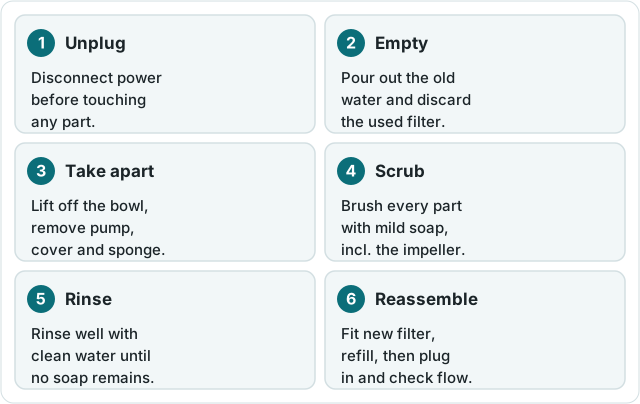
The six panels show the order: unplug and empty, take the pieces apart, wash the large parts, brush the pump and impeller, rinse everything, then reassemble with a fresh filter and refill.
How often should you clean it?
The ASPCA advises washing and refilling a cat's water bowls daily. A fountain is harder to wash, and no maker we checked asks for a daily teardown, but the principle holds: clean water beats long-standing water. Here is what manufacturers say in our database.
| Maker | Cleaning interval stated | Filter interval stated |
|---|---|---|
| Pioneer | Weekly clean, pump about monthly | Every 2 to 4 weeks |
| PawsPik | Pump and fountain every 2 to 4 weeks | Every 4 weeks (manual), 2 to 4 weeks (product page) |
| PETLIBRO (Dockstream 2) | Rotor and filters about every 2 weeks, more often with several pets | About every 2 weeks for one pet |
| Catit | Rinse the filter regularly without soap | Every 3 to 4 weeks |
| PetSafe | Clean the pump when it gets noisy or weak | Foam 1 to 2 months, carbon 2 to 4 weeks |
| Oneisall | Clean the pump when flow drops or it gets loud | Carbon every 15 days in most manuals (2 to 4 weeks for the 7 L model); foam 1 to 2 months (7 L model) |
Multi-cat homes, long-haired cats and hard water all shorten these intervals. Our filter schedule has the per-model detail.
Step-by-step cleaning
- Unplug and empty. Pull the plug, lift out the pump and pour out the water. Never wash a pump or cable under running water while it is plugged in.
- Take it apart. Remove the lid, tray or bowl, filter housing and pump cover. A photo of the assembled fountain helps you reassemble it.
- Throw out or set aside the filter. Replace it if it is past its interval. Rinse reusable foam in plain water.
- Wash the large parts. Use warm water, a drop of mild dish soap and a bottle brush for the reservoir and a sponge for the bowl. Reach into corners, the spout and the underside of the tray.
- Brush the pump. Lift out the impeller, the small spinning part. PetSafe's cleaning page describes washing it in soapy water, scrubbing the motor cavity with a small round brush and then rinsing. PETLIBRO's rotor-style models tell you to clean the shaft only lightly.
- Rinse well. Soap left behind can make the water foam and taste odd.
- Reassemble. Fit a new filter (many need a short soak first), put the pump in fully submerged, refill to the MAX line and plug in.
Which parts are dishwasher-safe?
It depends on the model, so check the manual. From our model data:
- PETLIBRO's stainless steel fountain: all parts except the pump, pump holder, filters, flow controller and water outlet.
- PETLIBRO Dockstream 2: the stainless steel water tray.
- PETKIT Eversweet Max 2: tank, tray, lid, filter holder and outlet pipe. PETKIT's Solo 2 says no part is dishwasher-safe.
- Oneisall: stainless steel parts only (bowl).
- PetSafe Drinkwell: fountain parts, but not the pump.
- Catit stainless steel tops: the top section.
- iPettie Tritone: no dishwasher claim; the maker says the parts except the plug and pump can be washed.
Pumps, filters and electronics never go in the dishwasher. Even with dishwasher-safe parts, a hand scrub of the pump and spout is still needed.
Vinegar and descaling
White scale from hard water can build up on the pump and bowl. A common household approach is to soak parts in diluted white vinegar for a while, then rinse thoroughly. This is general practice rather than something every maker endorses, so check that your manual does not forbid it, and keep vinegar away from electrical contacts. PETLIBRO's own FAQ for rust marks on its stainless steel tray suggests a baking soda and water mix applied with a soft cloth, and a pet-safe stainless cleaner for stubborn marks.
What not to use
- Bleach or strong cleaners on parts your cat's mouth touches, unless the manual allows it and you can rinse them fully.
- Abrasive pads or steel wool on plastic or stainless steel. VCA notes that scratches can make plastic dishes more prone to bacterial contamination.
- Soap on the filter. PawsPik's manual warns that soap cannot be rinsed out of a filter.
- Boiling water on plastic parts, which may warp them.
Does bowl material change the work?
VCA says plastic dishes may be associated with chin acne in cats and that smooth, non-porous dishes such as glass or stainless steel may help in some cases. It does not mention ceramic. That does not mean one material needs less cleaning; any dish needs regular washing. See the materials guide for a careful comparison, or stainless steel fountains compared.
When cleaning does not fix it
If the water turns slimy again within days, read our slime and dirty water page. If the pump stays loud, see noisy pump. Ask your vet about any health concern; this guide does not replace veterinary advice.
FAQ
How often should I clean a cat water fountain?
Follow your manual. In our database Pioneer suggests weekly cleaning with a monthly pump clean, PETLIBRO suggests about every two weeks for the rotor and filters, and PawsPik says every two to four weeks. If the water looks cloudy, clean sooner.
Can I put my cat fountain in the dishwasher?
Only the parts your maker names. Many exclude the pump and filter, and some say no part is dishwasher-safe. Check the model's manual or our model data.
Is vinegar safe for cleaning a pet fountain?
Diluted white vinegar is a common household descaler, but we have not found a manufacturer page that endorses it for every model. Check your manual, and rinse all parts thoroughly so no smell or taste remains.
Do I need to clean the pump every time?
Not necessarily, but the pump collects hair and film. Pioneer says monthly, Oneisall and PETLIBRO describe cleaning it when flow drops or noise starts.
Sources
This page is general information and does not replace advice from your veterinarian.